
17. Visual Arts
THE PARTHENON
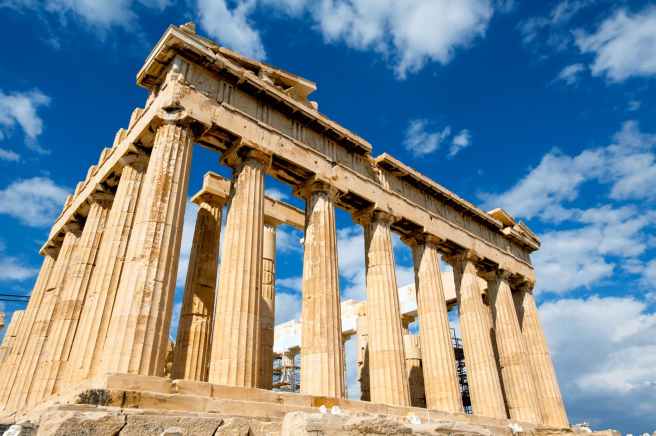
Commissioned by the famous statesman Pericles, the Parthenon was constructed between 447 and 432 BC to celebrate the victory of the Greeks over the Persians. Situated over the site of an earlier temple on the Acropolis in Athens, it was dedicated to Athena Parthenos, the patron deity of the city. The building is one of the most well-preserved Greek temples in existence.
According to the ancient author Plutarch, the Parthenon was built by the architects Ictinus and Callicrates. The thirty- eight-foot effigy insude was created by the classical sculptor Phidias, who also supervised the extensive sculpture of the structure’s exterior.
Ancient Greek temples were generally rectangular and accessible from all sides by stairs. Many, like the Parthenon, had columns that extended around the periphery. When building temples, the Greeks tended to follow the rules of one of three architectural orders__ Doric, Ionic, or Corinthian. The orders are easily reconizable by their differing proportions and their capitals__ the carved tops of their columns. Unlike most Greek tenples that were built according to the rules of one particular order, the Parthenon combined elements of two__ the Doric and Ionic. Its architects also made use of optical refinements, that is, slight distortions that enhanced the appetance of the building. For example, the base of the building and the roofline gently bow upward because if they were perfectly straight, the naked eyr would perceive them as sagging. Similarly the columns are thicker toward the bottom, a refinement that makes them appear taller to a viewer standing at their base.
Originally, the Parthenon had a wooden ceiling and a tiled roof, and it was painted in bright color. Square reliefs or metopes tan around the temple above the columns and depucted mythological battles that served as metaphors for the Greek victory over the Persians. A continuous frieze illustrating the annual festival of Athens Parthenos appeared beneath and behind the columns on the four walls of the bulding itself.
The Parthenon was used as a house of worship for many centuries agter the fall of Athens. It was onverted into a church in the sixth century, then into a mosque by the Turks who conquered Greece in 1458. Diring a battle in 1687, a Venetian shell landed on a Turkish powder keg stored in the temple and destroyed much of the building.
In 1801, Lord Elgin, the British ambassador to the Ottoman Court in Istanbul, received permission to ship the most well-preserved of the Parthenon’s sculptures to England, where he eventually sold them to the British government. Today they can be seen at the British Museum despite
efforts on the part of the Greeks to have the works returned. The temple itself has been visited by countless tourists since the Greeks regained control of Athens in 1832.

 Puzzle
Nice post..
LikeLiked by 1 person