Welcome to my Blog

This Blog was created to find new friends with good aprouch skills, happy and positive people, energetic and down to start new business with me.

“I’d” love to share with you all, the new things that have had happening in the past fiel decades “hehehe”..

I hope many of you get you enjoy internet and other activities like i do, going the parks, looking for good sandwish around and to make new quality friends.

MONDAY DAY 1| WEEK 4 HISTORY

ALEXANDER THE GREAT

Alexander the Great (356-323 BC) was born in Marcedonia, a mountainous kingdom in northern Greece, and educated by the famous Athenian teacher Aristotle. His father, King Philip II, had expanded Macedonia’s territory to include most of the ancient city- states of Greece, including Athens. Alexander inherited his father’s crown at age twenty, following Philip’s assassination at a theater.
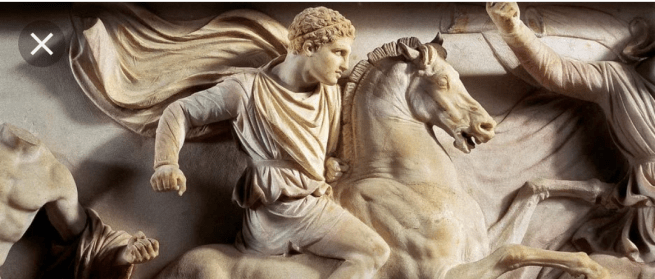
As king, Alexander surpassed his father by engineering an amazing string of conquests, creating an empire that encompassed much of Mediterranean world at the time. No other king had dominated such a wide swath of the ancient world. From his base in Marcedonia, Alexander’s armies conquered Greece, Syria, Egypt, Mesopotamia, and the Persian Empire.

In 330 BC, six years after he became king, Alexander defeated Darius, the king of Persia. Alexander eventually extended his kingdom as far as India. His reign ended abruptly when he died in the ancient city of Babylon at age thirty-three.

The empire Alexander created was divided among his offices, but it continued on for hundreds of years untill it was conquered by the Romans. In the conquered territories, Alexander and his troops had encountered new civilizations with different custom. Rather than simply destroy the cultures of defeated nations, the Greek absorbed them. A new, hybrid culture know as Hellenism emerged. For the first time in history, a large part of southeastern Europe and the near East spoke the same language and shared a cultural background. Greek remainded the lingua of the ancient world for centuries; the book of the New Testment were originally written in Greek. The cultural ferment caused by the arrival of Alexander’s armies remains perhaps his most meaningful legacy to the modern world.

Alexander remains of great interest today. Contemporary historians continue to examine his ruthless command of the army, his love for hourses, his study of philosophy, and, more recently, they have questined his sexual orientation.

ADDITIONAL FACTS

1. When Alexander was a child, he was unhappy with his father’s conquests. According to Plutarch, the young Alexander was sad that there would be less left for him to conquer when he became king.

2. After conquering Egypt, Alexander founded the city of Alexandria on the Mediterranean coast, one of a dozen cities he named after himself. In Alexandria, the Greeks built a gigantic library to house thousands of parchments. The library burned down a few centuries later, destroying a vast amount of knowledge about the ancient world

3. Alexander was an avid hunter, who reportedly hunted 4.000 animals, including lions, during a single hunt in what is now known as Uzbekistan. Ancient Greeks hunted game with a spear, a net, and little else.


Thursday, Day 4 18-science

THE SOLAR SYSTEM

In grade school, we were taught the solar system consists of the sun, nine planets, and their moons. It’s not that simple.

No one really knows how many planets there are because there is no settled scientific definition of a planet. All astronomers agree upon the validity of the four terrestrial planets__ Mercury, Benus, Earth, and Mars__and the four gaseous giants__ Jupiter, Saturn, Uranus, and Neptune__ but arctic Pluto is a matter of great dispute.

Pluto is about two-thirds the size of our moon and takes 248 years to orbit the sun. The tiny i e planet travels in a strange elliptical orbit on a different planet than then other eight. Its coldness, distance from the other planets, and warped path around the sun has led many scientists to believe that it is really a comet in the Kuiper Belt, a region of icy debrics on the outskirts of the solar system.

Pluto has a recently discovered rival on the Kuiper Belt, a hunk of frozen rock officially referred to as 2003 UN313 but informally called Xena. The object is three times farther from the sun than Pluto and has an even stranger 560-year orbit, tilted 45 degrees off the plane of the rest of the planets. But 2003 UB313 is larger than Pluto, and many scientists feel that if Pluto deserves to be called a planet, then it does, too.

ADDITIONAL FACTS

1.Two other Large frozen objects in the Kuiper Belt__ Quaoar and Sedna___ are almost as big as Pluto. They may become the eleventh and twelfth planets.

2.Astronomer Michael E. Brown discovered 2003 UB313 and nicknamed it Xena after the TV show starring Lucy Lawless as ancient Greek warrior princess. He hopes to make Xena the official name.

3.Our solar system has 153 known moons, but that nber is highly contested.

4.Seven moons in the solar system are Large than Pluto. This includes Jupiter’s Io, which has

SUNDAY, DAY 7-21 RELIGION

CAIN AND ABEL

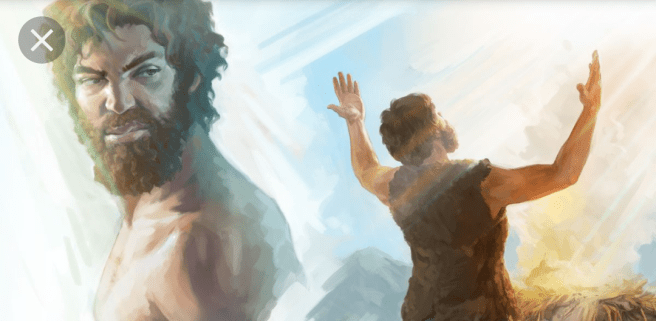
Cain and Abel were the eldest sons of Adam and Eve, born after their expulsion from the Garden Eden. Cain, the elder, was the first human being to be born__ as opposed to being created__according to the Torah. Cain tilled the Earth while Abel was a shepherd, herding lambs.

One day, God asked Cain and Abel to each make a sacrifice to him. It is said that Abel thought very hard about what kind of sacrifice would make God happiest. He decided to sacrifice one of his precious lambs. Cain, on the other hand, thought only about what he needed least. He sacrificed some fruit and grain. God clearly preferred Abel’s sacrifice.

Cain quickly became jealous of his younger brother and murdeded him. When God came to look for Abel, he could not find him. He asked Cain where Abel was. Cain replied, “I”” don’t know, Am I my brother’s keeper?” (Genesis 4:9)

After God realized what Cain had done, he punized him with a curse; he could no longer farm and had to wander for the rest of his life. Cain worried he would be harmed by people he met, so God placed a protective marking on him.

Besides the religious and moral lessons, the Cain and Abel story illustrates the historical conflict between people who were using the sparse fertile land for growing crops and those who were using it to raise livestock. A similar tale appereas in Sumerian culture about a beautiful goddess forced to choose between two suitors: a farmer god and a shephered god.

ADDITIONAL FACTS

1. The nature of the mark placed on Cain is not described. Some claim that it was a mark on his face or red hair. Still othe

rs argue that it was black skin, a theory later used to justify slavery.

2. On some Muslim version of the story, Abel is claimed to have offered no resistance while his brother murdered him and is seen as a symbol of pacifism.

SATURDAY, DAY 6 20-Philosophy

PLATO

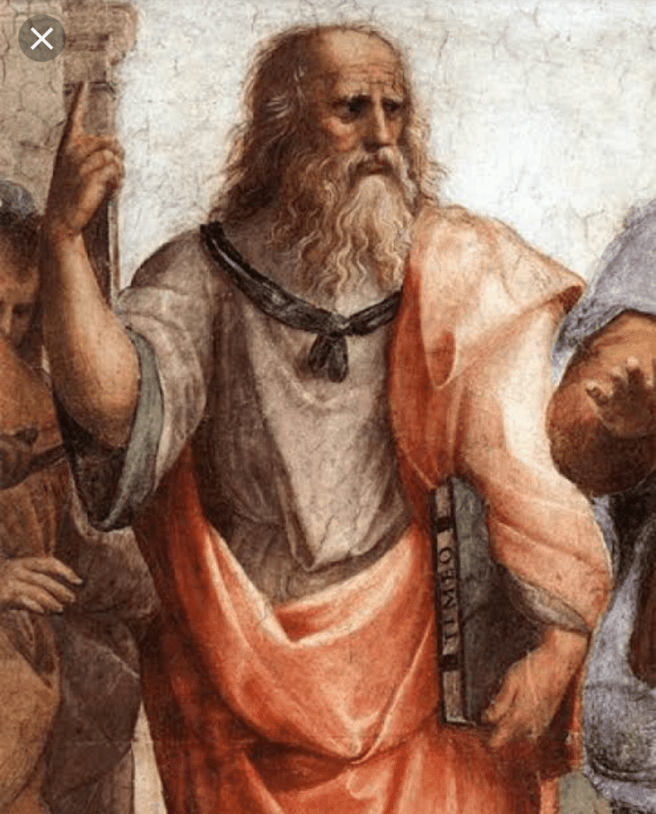
Plato (429-347 BC) was born in fifth-century Athens to a wealthy family. A young Athenian of his station would have been expected to pursue politics, but instead Plato followed the path of his mentor, Socrates (470-399 BC.), and became a philosopher.

Plato’s philosophical writings are dialogues in which two or more characters discuss a philosophial issue. The main character in most of Plato’s dialogues, is Socrates. Since Plato never speak in the dialogues, scholars face the question: How much of what Plato puts into Socrates’ mouth is Plato’s own philosophy, and how much is just a report of Socrates? Many sholars believe Plato’s earlier dialogues are historically accurate accounts of Socrates’ teachings. Later, they believe, Socrates became a literary character for Plato’s own purposes.

Plato is believed for his theory of forms____ abstract, immaterial things imitated by the physical objects of this world.

Another famous Platonic view is that all knoledge is recollection. Plato believe the soul was immaterial and existed before is inhabited a body . Before it was embodied, the soul knew the forms, without being distracted and limited by sensory perception. When human beings come to know something, it is because our soul recollect what they knew before they were embodied.

Furthermore, Plato divided the soul into three parts: the appetitive part (which desires sensual pleasure like food, drink, and sex), the spirited part (which desires glory and honor), and the rational part (which desires to understand the forms). im the dialogue The Republic, Plato describes what it is for a soul to be just, by drawing an extended analogy between a just soul and a just city. Plato describes the perfectly just city as having groups of citizens that correspond to the three parts of the soul. He believed those groups must harmoniously interact in the same way that the three parts of the soul should. In both cases, the soul and the city, Plato believed that the rational should dominate.

ADDITIONAL FACTS

1. Plato appears only in one of his dialogues, Apology, which describes the trial of Socrates, at which he is sentences to death. Plato says nothing in the dialogue,but his inclision that he was present at the actual event.

2. Plato was the teacher of Aristotle (384-322 BC).

FRIDAY, DAY 5 – 19 MUSIC

HARMONY

Music may start with a melody, but harmony is what gives it color. Harmony refer to the sounding of two or more different pitches in unison, bur the mechanics of harmony are vast and complicated, and many theorists have spent the better part of their careers analyzing it.

The distance between two notes is referred to as an interval, and intervals are expressed numerically. For example, the distance from A to E is called a fifth The earliest polypnonic music was written in the Middle Ages, and at that point composers favored the hollow-sounsing intervals of the fourth (i.e., C to F or D to G) and the fifth. Therefore, melodies would be followed by a parallel harmonic line one fourth or one fifth below.

By the Renaissance, however, the triad had become the main unit of harmony, remained so for centuries, and still is in many types of music. Triads are chords, or a combination of three or more notes heard simultaneously or in close succession, based on the interval of the third (i.e., E to G or B to D). The precise intervals that make up chords are what give them the quality of being major (bright, happy-sounding) or minor (dark, sad-sounding). The notes that make up a triad can also be tearranged to create an inversion, which is another tool that is used to vary harmony.

Harmony has many functions: to “add clothing” to a piece of music, to give music more depth, to echo or complement a melody line, or just to grounded accompaniment beneath a melody. Harmony that pleases the ear or seems stable or at rest is called consonance, while that which sounds harsh, unfamiliar, or unstable is called dissonance. Without the instability of temporary dissonance, tonal music would be boring; without the stability of consonance, it would be unsatisfying. The idea of what is consonant, or acceptable to our ears, has broadened over the course of music history. Even the question of whether consonance is essential has become debatable.

ADDITIONAL FACTS

1.Johann Sebstian Bach was known to construct masterful harmonies in his choral works, and in the twentieth century. Claude Debussy’s works were often driven by lush, shifting harmonies rather than by their melodies.

2. Sixth-century philosopher Pythagoras believed that the “purest” hamonies were based on mathematical ratios like 2:1, 3:2, and 4:3. He formulated this theory while listening to the sounds produced by blacksmith hammering anvils of various sizes at the same time.

3. The word harmony comes from the Greek harmonia, which means “fastening” or ” to join.”

THURSDAY, DAY 4 18-SCIENCE

THE SOLAR SYSTEM

I grade school, we were taught that the solar system consists of the sun, nine planets, and their moons. It’s not that simple.

No one really knows how many planets there are because there is no settled scientific definition of a planet. All asyronomers agree upon the validity of the four terrestrial planets___ Mercury, Venus, Earth, and Mars___and the four gasseous giants___Jupiter, Saturn, Uranus, and Neptune___but arctic Pluto is a matter of great dispute.

Pluto is about two-thirds the size of our moon and takes 248 years to orbit the sun. The tiny ice planet travels in a strange elliptical orbit on a different plane than the other eight. Its coldness, distance from the other planets, and warped path around the sun has led many scientists to believe that it is really a comet in the Kuiper Belt, a region of ice debris on the outskirts of the solar system.

Pluto has a recently diacovered rival on the Kuiper Belt, a hunk of frozen rock officially referred to as 2003 UB313 but informally called Xena. The object is three farther from the sun than Pluto and has an even atranger 560-year orbit, tilted 45 degreesodf the plane of the reat of the planets. But 2003 UB313 is Larger than Pluto, and many acientista feel that if Pluto deserves to be called a planet, then it does, too.

ADDITIONAL FACTS

1.Two other Large frozen objects in the Kuiper Belt___ Quaoar and Sedna___are almost as big as Pluto. They may become the eleventh and twelfth planets.

2.Astronomer Michael E. Brown discovered 2003 UB313 and nicknamed it Xena after the TV show atarting Lucy Lawless as an ancient Greek warrior peincess. He hopes to make Xena the official name.

3.Our solar system has 153 known moons, but that number is highly contested.

4.Seven moons in the solr system are Larger than Pluto. This includes Jupiter’s Io, which has an atmosphere and active volcanoes.

Wednesday

17. Visual Arts

THE PARTHENON

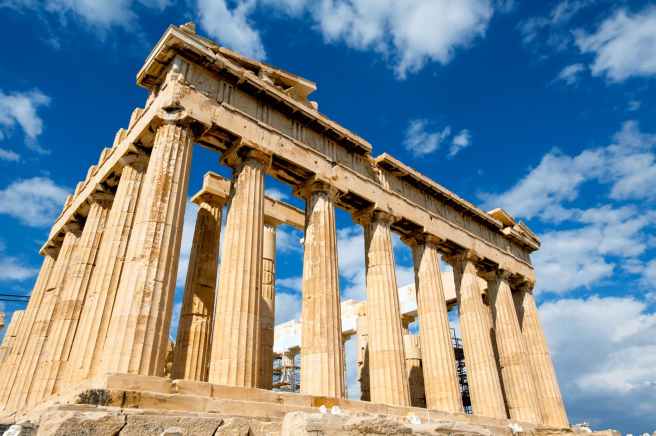
Commissioned by the famous statesman Pericles, the Parthenon was constructed between 447 and 432 BC to celebrate the victory of the Greeks over the Persians. Situated over the site of an earlier temple on the Acropolis in Athens, it was dedicated to Athena Parthenos, the patron deity of the city. The building is one of the most well-preserved Greek temples in existence.

According to the ancient author Plutarch, the Parthenon was built by the architects Ictinus and Callicrates. The thirty- eight-foot effigy insude was created by the classical sculptor Phidias, who also supervised the extensive sculpture of the structure’s exterior.

Ancient Greek temples were generally rectangular and accessible from all sides by stairs. Many, like the Parthenon, had columns that extended around the periphery. When building temples, the Greeks tended to follow the rules of one of three architectural orders__ Doric, Ionic, or Corinthian. The orders are easily reconizable by their differing proportions and their capitals__ the carved tops of their columns. Unlike most Greek tenples that were built according to the rules of one particular order, the Parthenon combined elements of two__ the Doric and Ionic. Its architects also made use of optical refinements, that is, slight distortions that enhanced the appetance of the building. For example, the base of the building and the roofline gently bow upward because if they were perfectly straight, the naked eyr would perceive them as sagging. Similarly the columns are thicker toward the bottom, a refinement that makes them appear taller to a viewer standing at their base.

Originally, the Parthenon had a wooden ceiling and a tiled roof, and it was painted in bright color. Square reliefs or metopes tan around the temple above the columns and depucted mythological battles that served as metaphors for the Greek victory over the Persians. A continuous frieze illustrating the annual festival of Athens Parthenos appeared beneath and behind the columns on the four walls of the bulding itself.

The Parthenon was used as a house of worship for many centuries agter the fall of Athens. It was onverted into a church in the sixth century, then into a mosque by the Turks who conquered Greece in 1458. Diring a battle in 1687, a Venetian shell landed on a Turkish powder keg stored in the temple and destroyed much of the building.

In 1801, Lord Elgin, the British ambassador to the Ottoman Court in Istanbul, received permission to ship the most well-preserved of the Parthenon’s sculptures to England, where he eventually sold them to the British government. Today they can be seen at the British Museum despite

efforts on the part of the Greeks to have the works returned. The temple itself has been visited by countless tourists since the Greeks regained control of Athens in 1832.